Johnson family celebrates 50 years of organic farming
Published: September 23, 2025
Category: Organic Farmer Profile
Advertisements

By Wren Murphy, Madison Daily Leader
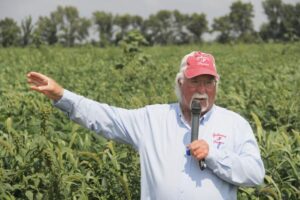
Charlie Johnson speaks at a field day
A 50-year legacy grew out of conversations around the dinner table, Jolene Johnson recalled.
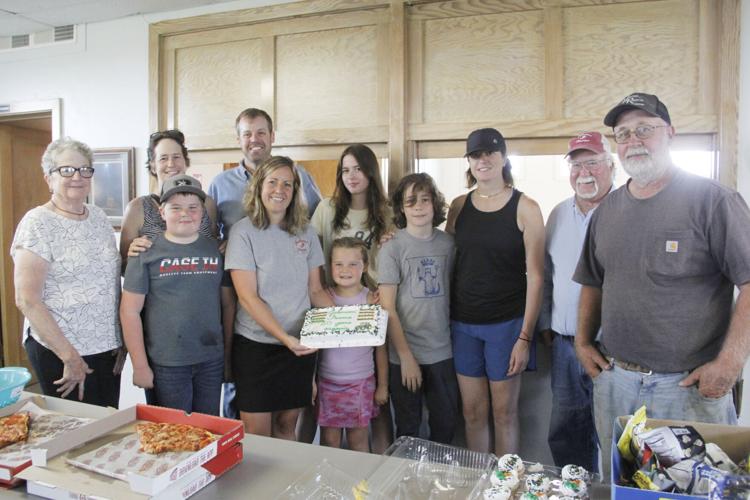
In 1975, Bernard and William “Bill” Johnson, Jolene’s husband, decided to go organic, no longer using synthetic pesticides or fertilizers due to their concerns about safety and the environment. Charlie, Allan and Kevin, Bernard’s sons, and Aaron, William’s son, as well as Charlie’s son, Jordan, have continued on with that tradition. To celebrate the 50-year milestone, Johnson Farms hosted a half-day open house, complete with a roundtable discussion and tour in partnership with the Northern Plains Sustainable Ag Society at St. Peter on the Prairie on Aug. 7. While this is not the operation’s first open house, Charlie Johnson did say it was a “special day” for the family.
For Jolene, the day gave her time to reflect on the decades of farming, the dedication and the family bonds that have made the farm work for so long. What started as a trial of organic farming with a different type of crop rotation turned into a point of familial pride.
“It’s been very successful and frustrating at times,” Jolene told the Daily Leader. “Aside from that, I’m grateful that my son (Aaron) has decided he wanted to take on the farm and do this, and with Charlie and Allan and Kevin and the Johnson group, it’s been very good.”
For Charlie, it makes him feel one way: humble.
He has operated the farm since 1981, helping take over his father’s half after he had a stroke five years after the transition to organic. It’s not always easy, and like all farmers, he experiences more than his fair share of stress about the weather and markets, but it’s all worth it at the end of the day. Between their partners like Prairie Hybrids and Farm Credit Services, the landowners they lease from, insurers, neighbors and other organizations, this wouldn’t be possible, in Charlie’s view.
“I’m glad that my dad made that decision. It’s in honor of him and my late uncle, and it’s still a family enterprise,” he said.
For Johnson Farms, organic is not simply a way to get a premium price on their crops, Charlie stressed. It’s about principle and philosophy, about being the best stewards of the land that they can be and doing what they believe is best for their family. As Charlie reminisced, he said his father would not put anything on crops if he couldn’t put it on the tip of his tongue without it hurting him.
“He strongly believed that land and soil was a community of living organisms, and as much as we’re being educated today now, not only in the organic world but also all the farming world, … (we know that) soil is life and soil is community,” Charlie told the audience.
Jolene shared that concerns about the safety of pesticides contributed to Bill’s decision to go organic, as well.
“When he (Bill) would come in at night, he’d say, ‘I can taste the chemicals in my mouth and I don’t like it,’” she said.
Aaron was born in 1980 and thus grew up with the farm firmly on its organic path. As he became an adult, he worked for the Hefty Seed Company before the opportunity came for him to return as an employee to his cousins. After a while, he took on his own organic operation, but even with the businesses separate, those family ties are still there.
“We all help each other out where we can,” Aaron said.
Krysti Mikkonen, the executive director for the Northern Plains Sustainable Ag Society, praised the event as an opportunity for education, which is key to the society’s mission. All farmers, regardless of their farming methods, are doing the best they can to serve the public, and events like these are ways to share the many possible paths that farmers can take, Mikkonen added.
“It’s a time to get together and gather and be proud of what you’ve done, but also to give back and share the story of the why behind what we’re doing,” Mikkonen said. “This isn’t an us versus them, conventional versus organic. We are all trying to feed the world.”
Organic farming
Event participants ranged from members of the family, to veterans of the agriculture industry to those from the public who were interested to learn more. No farming operation is identical to any other, and Charlie said Johnson Farms has found its stride with a six-year crop rotation that Bill and Bernard were introduced to in the 1970s.
The rotation starts with oats, followed by two years of alfalfa. The alfalfa can be baled and used to feed the animals in the family’s cow-calf operation.
“Our cows eat pretty well,” Charlie said, chuckling.
After three years of these smother crops, which help suppress weeds, traditional row crops are brought in, with soybeans, then corn and a return to soybeans. When possible, the farmers try to work in winter rye as a cover crop.
While this winter was marked by drought, this summer has offered more rain than he is comfortable with, causing a particular challenge to the smother crops. Oats, for example, are usually harvested by Aug. 1, but they’re still in the fields. This is a “very rare” situation for them to be in, Charlie said.
Attendees were brought to numerous fields during the tour, ranging from acres that were new to organic farming to ones that have been organic since the beginning, learning about ways to reduce damage from insects as well as drifting pesticides from other farms. Weeds are reduced with the help of the smother crops, and insects tend to be less of a problem when the crops are healthy, Charlie said. Drifting pesticides are battled with buffer zones, though they’re not always 100% effective.
Once all the row crops are harvested, they’re shipped out of state for sales and processing, he said. Most of the grain is sold in the Mississippi River Basin area for a premium price, Charlie said, including to farmers with organic cattle. Locally, they sell their beef and deliver eggs.
Challenges will always come about, whether due to the specifics of organic farming or to the common weather woes, but it’s always an opportunity to grow, Charlie shared. And with 50 years of organic family farming and the support of their relatives and partners, these problems can be met head-on and can provide good experience going forward.
“The thing I like best about organic farming is you have a chance every year to learn what you can do better,” Charlie said.
This article was reprinted with permission of the Madison Daily Leader.
https://www.madisondailyleader.com/news/local/article_6c586e8a-814e-4f3a-9fa6-4b237065703a.html
Organic & Non-GMO Insights October 2025
Advertisements