Weather variability is shaping production risk, while tightening organic grain markets are amplifying the value of quality.
By Kendra Morrison
The numbers entering the 2026 harvest season point to a growing divergence across U.S. crop production regions. While some growers are managing excess moisture and delayed crop development, others continue to contend with drought and limited rainfall. At the same time, organic grain markets remain relatively tight, increasing the financial consequences of grain quality losses and amplifying price sensitivity across key commodities.
Taken together, USDA crop reports, NOAA climate data, and organic grain market indicators suggest harvest outcomes may be increasingly determined by a producer’s ability to preserve grain quality under highly variable regional conditions.
According to NOAA, portions of the Upper Midwest experienced one of their wettest Aprils on record in 2026. Wisconsin and Michigan recorded their wettest April since statewide records began, while several neighboring states received precipitation totals well above historical averages. In contrast, drought conditions persisted across portions of the High Plains, Southeast, and western edges of the Corn Belt.
Those differences are already visible in USDA reporting. Oklahoma’s June Crop Progress and Condition Report showed winter wheat harvest just 5 percent complete compared to a five year average of 22 percent. Topsoil moisture was rated 24 percent surplus while winter wheat conditions stood at 50 percent good to excellent and 17 percent poor to very poor.
Nationally, corn planting reached 97 percent complete by early June, slightly ahead of the five year average of 96 percent. Soybean planting reached 90 percent compared to a five year average of 88 percent.
Alexander Schultz, organic grain market analyst at Mercaris, said those regional differences are already shaping production expectations.
“There are absolutely regional concerns for the 2026 crop,” Schultz confirmed. “Moisture conditions are overall positive across much of the Corn Belt and upper East Coast, which were supportive for planting. However, the High Plains and Southeast are still experiencing strong drought.”
The regional production outlook comes at a time when organic feed grain supplies are already constrained.
“Organic corn and feed grade wheat supplies are both extremely tight ahead of the fall harvest because of dramatic growth in organic feed demand,” Schultz explained.
He pointed to expanding demand across multiple livestock sectors. Organic chicken production has grown over the past two years, the organic layer market has added nearly 6 million birds, and the organic dairy herd expanded in 2025 for the first time since 2021. Together, those trends have increased demand for feed grains at a time when domestic supplies remain limited.
Buyers are competing more aggressively for available grain. Schultz clarified that prices for organic corn have risen sharply over the past six months as buyers seek increasingly scarce domestic supplies. While imports remain available, volumes are limited and costs remain relatively high.
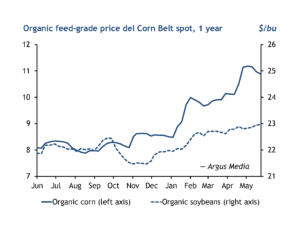
Figure: Rising organic corn prices suggest markets are already responding to tightening feed grain supplies and harvest uncertainty. Organic soybean prices remained relatively stable, reflecting differences in supply conditions between the two commodities. Source: Argus Media.
The organic corn premium over conventional corn exceeded $6.75 per bushel in early June, nearly double the $3.57 premium recorded one year earlier. Organic soybean premiums remained comparatively stable at approximately $11.73 per bushel, supported by increased imports from Africa and the Black Sea region.
The growing importance of quality may prove just as significant as supply. Research from the USDA Agricultural Research Service has consistently linked prolonged moisture during flowering and grain fill periods with increased risk of diseases such as fusarium head blight and the associated mycotoxin deoxynivalenol.
Schultz revealed that buyer responses are beginning to diverge. Some are becoming more quality sensitive to ensure consistency, while others are showing greater flexibility in order to secure supplies. However, flexibility often comes with costs.
“Failure to meet a buyer’s quality specs may require the seller to move the grain to a buyer with lower standards,” Schultz stated. “That would likely lead to a lower price to the farmer.”
Schultz shared that the organic hard red winter wheat harvest in parts of the High Plains looks poor following a season of drought, with some growers reporting more than 80 percent abandonment. Yet the wheat that is harvested may carry unusually high protein levels, creating additional challenges for millers seeking to meet specific quality requirements.
Despite the risks, opportunities remain for growers able to deliver consistent quality.
“These farmers will benefit from being able to sell into buyers with higher standards, who often have higher bids,” Schultz disclosed. “They will benefit even more from growing food grade products, which often have higher standards but higher premiums as well.”
Some producers are also exploring diversification strategies to reduce weather related risk. Schultz noted growing interest in oats and identity preserved soybeans, supported in part by new processing infrastructure under development in southern Minnesota. However, he said broader diversification will depend on continued expansion of market opportunities.
Advertisements