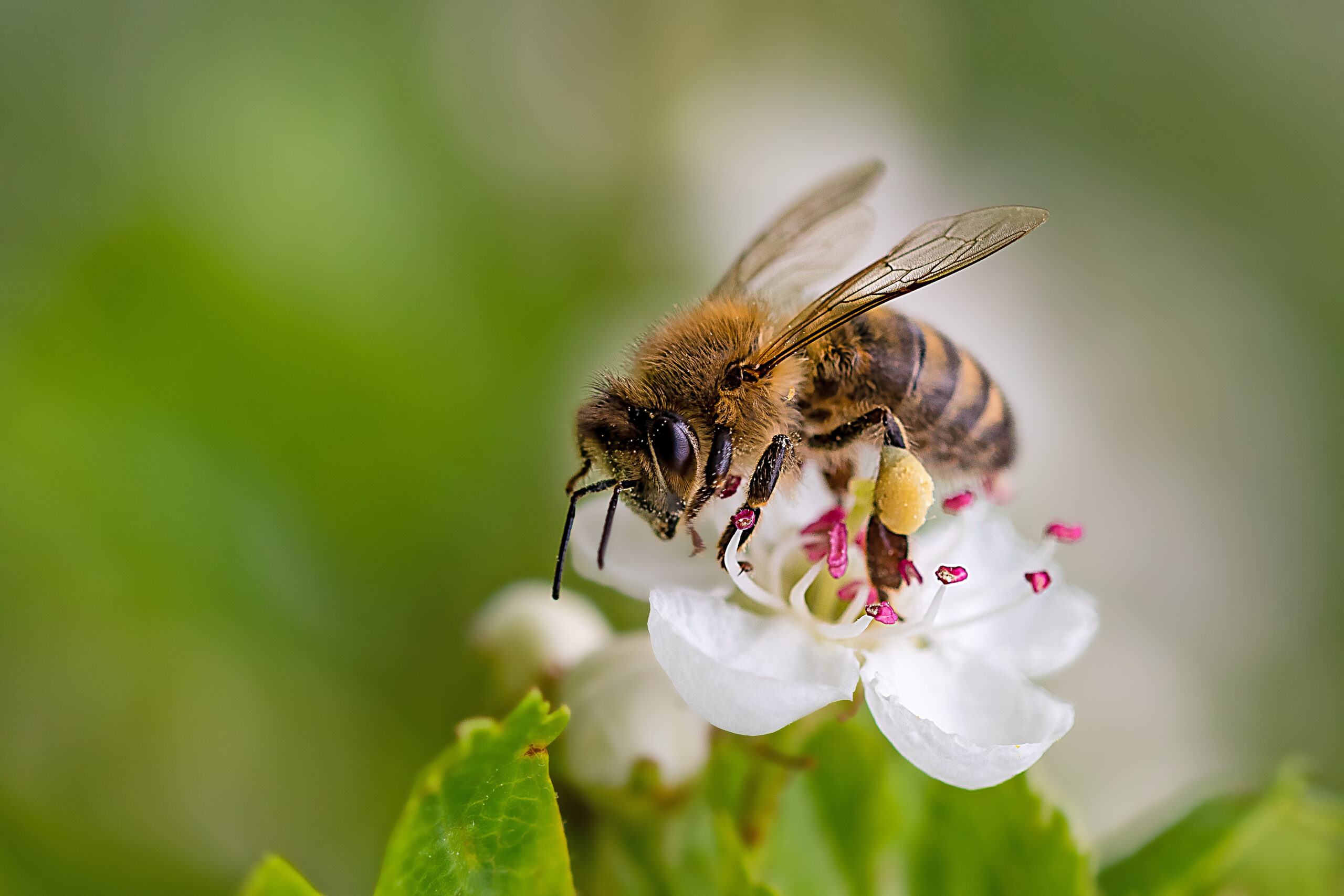
By Titanilla Kiss
Article originally published at https://substack.com/@beewitchingembassy
That opening might surprise you. We have all heard the famous claim, often attributed to Einstein (he almost certainly never said it), that humanity would have four years left if bees vanished. It is a quotable idea. It is also wrong. But correcting it is not the same as dismissing the problem and this is where things get genuinely interesting.
The Calories Would Survive
The crops that feed most of the world’s population are grasses. Wheat, rice, maize, barley, oats and sorghum are all wind pollinated. They do not need bees, flies, beetles, or anything with wings and a preference for flowers. They need air movement and proximity. These staple crops produce the bulk of global calories and they would continue to do so in a world without pollinators.
Imagine walking down a supermarket aisle. The bread, rice, and pasta would still be there, but the fruits, nuts and many vegetables would vanish from sight.
This matters because it means that a pollinator collapse would not trigger mass starvation in the dramatic, sudden sense that the Einstein myth implies. People in wealthy nations might face dramatically less varied diets. People in poorer nations, already dependent on staple grains, would face a nutritional crisis of a more insidious kind.
What You Would Actually Lose
Titanilla Kiss from Bee Witching Embassy
Here is where the real story begins. Bees and other pollinators are essential to roughly 87 of the world’s leading food crops. That includes apples, almonds, blueberries, cucumbers, pumpkins, courgettes, many seed crops, coffee, cocoa, sunflowers and a large portion of the vegetables and fruits that nutritionists spend their careers encouraging you to eat more of.
A 2022 modelling study published in Environmental Health Perspectives estimated that current pollinator shortfalls already contribute to around 427,000 excess deaths per year globally, not through starvation, but through nutritional deficiency and the diet-related diseases that follow from it. A world without pollinators would produce calories but strip out micronutrients, vitamins and dietary variety on a large scale.
A 2024 economic modelling study found that a full pollinator collapse would push global crop prices up by around 30 percent and result in a welfare loss approaching 730 billion US dollars, alongside an 8 percent reduction in global vitamin A availability. That is not science fiction. That is a plausible arithmetic consequence of a specific ecological loss.
A global meta-analysis published in Nature Communications in 2023 confirmed that animal pollination does not just affect how much fruit or vegetable is produced, but also its quality: appearance, shelf life and to a lesser extent nutritional content. Pollinators, in short, are not just ticking boxes in the food system. They are actively improving what ends up on your plate.
Bees Are Not Alone
It is also worth remembering that bees are not the only pollinators. They are important and honeybees in particular are managed at scale for commercial pollination.
But the pollinator community includes hoverflies, beetles, butterflies, moths, wasps, some species of birds and bats. Many of these are also in decline, which is why the conversation about pollinator health is really a conversation about biodiversity and habitat, not just about one insect.
Wild pollinators, it turns out, often do a better job than managed honeybees when it comes to certain crops. Research has consistently shown that diverse pollinator communities improve both yield consistency and cross-pollination quality. A farm surrounded by flower-rich habitat supporting many different pollinator species tends to outperform a farm relying on rented honeybee hives alone.
The Invisible Infrastructure
The most useful way to think about pollinators is as infrastructure. Roads, water pipes and electricity grids are infrastructure too. Most people do not think about them until they fail.
Pollinators are the infrastructure of ecosystems: invisible, taken for granted and expensive to replace once they are gone.
Wild plant communities also depend on pollinators. Roughly 87 percent of all flowering plant species require animal pollination to reproduce. Remove pollinators and you do not just affect agriculture. You begin to unravel the plant communities that underpin habitat for every other organism, including us.
What to Do About It
The good news is that the solutions are not especially complicated or expensive. They are just not yet widespread enough to matter at scale. Protecting and restoring semi-natural habitats near farmland, reducing pesticide use particularly of neonicotinoids, planting diverse flowering strips in and around agricultural land and supporting small-scale and diversified farming systems all help.
These are not radical demands. They are sensible ecological maintenance. A diverse, resilient pollinator community is cheaper to sustain than it is to replace. No one has yet figured out a cost-effective mechanical alternative to a bumblebee finding a flower on a cold morning in April.
The world without bees would not end. But it would be considerably worse: less varied, less nutritious, less resilient and considerably less interesting to look at. That seems like sufficient reason to pay attention. Right?
Advertisements