By William F Brinton
In Germany, an intriguing marketing experiment has been underway—one that anyone hoping to make alternatives succeed ought to pay attention to. It took two recent visits to Europe for me to grasp what was happening.
I noticed it most clearly while exploring markets and natural-food restaurants along Lake Constance (Bodensee), where the city of Konstanz lets you step into either Germany or Switzerland simply by crossing a street. Everywhere were subtle hints of a culture that had embraced organic agriculture as something entirely normal.
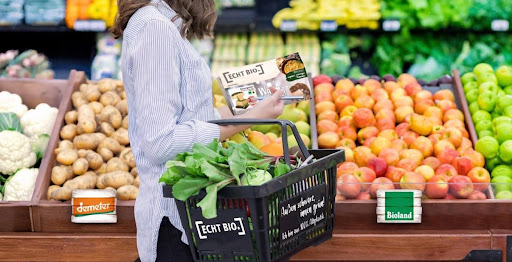
What first caught my eye were the street posters, shopping carts, and recipe flyers—all carrying an unfamiliar label: ECHT BIO. Literally: Real Organic. (It has no connection to the Real Organic Project in the U.S.)
Months earlier, I had already seen the label while talking with farmers and retailers in Northern Germany, near the Danish border. In that region, roughly one in four farms is certified organic. Nationally it is one in seven. Austria and Denmark are even higher. According to Switzerland’s FIBL—the gold standard in organic statistics—Germany farms 11.4% of its land organically (14.2% of farms). The U.S., by contrast, remains a little over 1%, reaching 9% only when USDA counts “no-till with cover crops” as regenerative. That contrast alone tells a story.
Earlier research led me to conclude that late-19th-century Lebensreform (life-reform) ideals in German-speaking Europe created a cultural receptivity to “bio-farming”—a resistance to industrial agriculture long before it hardened elsewhere.
But this new encounter with ECHT BIO made me realize something more contemporary may also be at work: positive, coordinated marketing.
What Is ECHT BIO?
ECHT BIO is a registered label created by Die Regionalen (“The Regionals”), a cooperative GmbH composed of independent organic shopkeepers, natural-food specialists, and bio-supermarkets across Germany. Their stated purpose is to “keep independence alive while upholding the core values of bio-organic farming.”
Importantly, Die Regionalen doesn’t own stores or products. This distinguishes it from Germany’s major natural-food chains such as Alnatura, founded in 1984 by Anthroposophist Götz Rehn. Alnatura recently reincorporated as a foundation to avoid the kind of corporate sell-outs that overtook Whole Foods or Stonyfield in America. ECHT BIO’s role is different: it lifts natural and organic goods through cooperative marketing rather than ownership.
And here is the striking point: we have nothing comparable in the United States.
ECHT BIO acts as a unifying banner across the diverse ecosystem of German organic farming—Demeter (biodynamic), Bioland, Naturland, and the mandatory EU organic label (“the minimum standard”). It presents these differences clearly without blurring them.
Perhaps this is one reason why 97% of German households purchase some bio-food, according to the Ministry of Agriculture. In Germany, diversity is the strength. In the U.S., it feels as though we lack diversity to unite behind—or lack the will to.
Marketing as a Form of Literacy
One of the most telling features of ECHT BIO is its relentless positivity. Recently the label ran a campaign showing how an entirely organic lifestyle can be affordable—highlighting college students on tight budgets. (Imagine such a message gaining traction in the U.S., where price stigma around organic remains stubborn.)
ECHT BIO also runs rolling Aktion promotions: bi-weekly in-store specials, recipe cards, seasonal posters, and take-home flyers. It is marketing, yes—but also education. It teaches shoppers how to plan and cook meals using organic ingredients, and how to do so economically.
This lowers the threshold for participation and counters the American assumption that organic is a luxury label. Because ECHT BIO works across hundreds of independent shops, it builds consumer trust in a way that no single brand or certifier could.
Alongside this are the large advertising efforts of Germany’s “big three” organic certifiers—Demeter, Bioland, and Naturland—supported by networks of natural-food stores. In Europe, growth comes from multiplicity, not consolidation.
A vivid example of this literacy-by-design emerged this summer when the German Ministry of Agriculture launched ECHT KUH-l—a bilingual pun folding together “Real Cow” and “Really Cool.” It invited students, schools, and communities to submit creative projects connecting farming, animals, soil, and food. The humor works only in a culture already fluent in “bio,” yet behind it lies a serious intent: strengthening bio-regional awareness through public engagement.
Why the U.S. Fell Behind—and Stayed There
Looking closer, it becomes clear that the conditions enabling ECHT BIO to thrive in Europe are precisely the ones the U.S. weakened over time.
Under President Carter, Secretary of Agriculture Bob Bergland initiated the first official USDA recognition of organic farming (1979), culminating in the influential 1980 Report and Recommendations on Organic Farming. For a moment, it appeared the government might champion the movement it had once opposed.
But when the USDA Organic Label was finally created years later, the process emerged around mistrust of the existing farmer-led certifiers. Centralization was meant to unify, but instead it eliminated dozens of independent initiatives—replacing diversity with a single federal gatekeeper.
The loss of this plural ecosystem left the U.S. with a national program that is under-funded, conservative, and heavily bureaucratic. It also left consumers with far fewer ways to connect emotionally or culturally to the movement.
Ironically, Europe—often caricatured by Americans as over-regulated—now has a more democratic, vibrant, and market-responsive organic sector than the United States.
What We Can Still Learn (or Remember)
The cooperative spirit behind ECHT BIO is unmistakable—and rare in the U.S. food sector. Even if ECHT BIO vanished tomorrow, Europe would retain its constellation of independent eco-certification programs, each acting with autonomy that no Brussels directive has erased.
Europe also has flexibility the U.S. lacks: for example, organic products sold unpackaged need not carry the EU organic logo, whereas in the U.S., USDA Organic is required regardless of packaging.
Central Europe benefited from an early start—one obscured to many Americans by language barriers. But the deeper difference lies in the intellectual and cultural history of the German-speaking world: a resistance to Enlightenment reductionism, a literary and philosophical tradition feeding the Lebensreform movement and, indirectly, America’s own transcendentalism. That thread has nearly disappeared here.
Beyond culture, Europe still succeeds at unifying diversity under a positive message—something the U.S. struggles to do.
Here, attempts to move forward often multiply confusion. “Carbon farming” diverted attention and diluted what organic already stood for. “Regenerative” resurrected many organic principles but without grounding or accountability. We keep inventing labels and frameworks, mistaking novelty for progress—treating “disruptive technology” as a creed rather than a caution. We should ask: is any of it working?
Still, I remain hopeful. Organic and regenerative agriculture in the U.S. could move beyond their current plateau. But any shift must resist our national instinct to turn every idea into a sweeping generalization—to monetize first and unify later.
Once you consider the examples above, the challenges become clear:
honoring farmer-led programs? Rarely done.
Imagining cooperative marketing? Possible, but overshadowed by negative messaging.
Creating a shared sense of accessibility and meaning? Difficult in a culture fractured on fundamentals.
So, we are left with noise: brand names, government-sanctioned greenwashing, competing labels, and a public unable to distinguish one movement from another. Even science falls into the same trap.
Europe, despite its bureaucracy, maintains a sense of continuity—carrying ideas forward rather than reinventing them every decade. It is not all roses: agribusiness interests push back, and cynicism is rising. With the surge in bio-foods, some fear a cheapening of quality. Even there, the ground shifts.
Still, the irony remains: the way forward for American agriculture may not lie in the next buzzword, but in rediscovering neglected insights. Maybe the future, as it often does, lies waiting quietly in the past. As Harry S. Truman reminded us:
“There is nothing new in the world except the history you do not know.”
WFB/Dec 2025
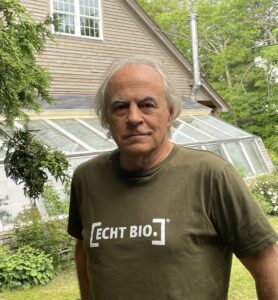
BIO: Dr. Will Brinton founded Woods End Soil Laboratory in 1975 and presently continues organic farming research in the Usa and Europe with the non-profit Will Brinton Foundation Inc.
Advertisements