Insights from Dan Brisebois on seed stewardship.
By Kendra Morrison
Seed is the starting point for innovation, flavor, and market opportunity. As climate variability, rising input costs, and supply chain disruptions impact the agricultural landscape, seed sourcing has become an increasingly strategic decision for organic and non-GMO growers.
While commercial seed systems remain essential, some farmers are also integrating on-farm seed production as a way to manage risk under real-world conditions.
Dan Brisebois, a seed farmer and educator based in Quebec, Canada, has spent more than two decades working at the intersection of market farming and seed production. He is the host of Seed Farmer podcast, co-founder of Tourne-Sol cooperative farm, and the author of The Seed Farmer: A Complete Guide to Growing, Using, and Selling Your Own Seeds. His work emphasizes seed stewardship as a response to agronomic uncertainty rather than an ideological stance.
Commercial seed catalogs and standardized trials capture certain performance traits well, particularly for crops grown under moderate and widely shared conditions.
However, Brisebois informs that these systems often fall short when applied to farms operating in more challenging environments.
“The more extreme your bio region, the less a seed catalog will have selected adequately for it when they would’ve done their trials,” he said. In his own context, that means short growing seasons, usually wet summers, and cold winters.
“Folks aren’t breeding necessarily with our needs in mind,” Brisebois said, noting that seed companies must prioritize varieties that perform consistently across large markets.
As a result, varieties suited to niche climates or organic systems may receive less attention or be discontinued altogether. “If something doesn’t make enough money in a seed company, they can phase it out,” he informed. “If it’s an important variety for us and a seed company phases it out, then it’s gone.”
Rather than framing this as independence, Brisebois emphasizes adaptability. “I would call it resilience,” he states. “It’s not so much about being independent and being self-sufficient. It’s about being able to adapt when situations change, and we can’t rely on what we normally rely on.”
That distinction became especially clear during the COVID-19 pandemic, when seed shipments were delayed across borders and within domestic markets.
“Packages were taking three months to get to people,” Brisebois said. “If you had your own seed, this wasn’t an issue.” While shipping times have since improved, he notes that “seed prices have risen an incredible amount,” adding that economic considerations are becoming harder to ignore for growers operating on tight margins.
Beyond cost and availability, farm-based seed work also provides growers with a deeper understanding of how seed quality is shaped. “They start to understand a little bit more what it means to get seed,” Brisebois explained. “They have better questions to ask about the seed that they’re purchasing.” When growers manage their own seed, they can track germination rates, disease pressure, and varietal performance directly.
“You have a better idea of the history of it,” he clarified. “And if there’s a problem due to the seed, you kind of know why.”
One of the largest barriers to wider adoption is not feasibility, but familiarity. “If you went back 60 years ago, market growers knew how to do it,” Brisebois said. “It is not common knowledge now.” With many first-generation farmers entering the industry, seed saving is often perceived as technically complex or risky.
Brisebois pushes back on that perception by emphasizing crop-specific differences. “Tomatoes are very easy to keep seed and keep true to type,” he said, as long as they are open-pollinated. Peppers fall into a similar category. Other crops, particularly cross-pollinated ones such as corn, squash, or carrots, require more attention to isolation and timing. “It’s all jumbled in people’s minds as one thing that’s hard to do,” he elaborated. “But there are actually some places that are really easy to start.”
Climate variability adds another layer of complexity. Brisebois described increasingly erratic conditions, from unusually hot springs that disrupt pollination to extreme rainfall events that can destroy seed crops. “We suddenly have really hot springs and certain things won’t fertilize at that point,” he shared. In response, growers are adapting their production practices, including the use of greenhouses and tunnels to ensure seed crops reach maturity.
At the same time, selection decisions must account for future uncertainty. “If you have a really hot year and you select for that, you might be inadvertently removing genes that are good for a colder year,” Brisebois cautioned. “You have to leave enough diversity to be able to select in a future year for other conditions.” This trade-off between uniformity and diversity reflects broader tensions in plant breeding, particularly for growers serving direct markets where visual consistency may matter less than resilience.
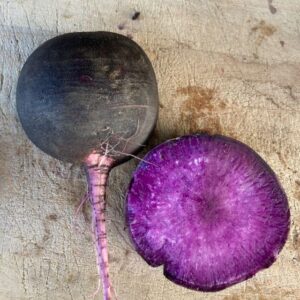
While risk mitigation is a primary driver, Brisebois also sees opportunity in farm-based seed work as a source of differentiation and long-term value. “You can wind up with varieties that nobody else has,” he continued, “When I started farming, kale was something that not everybody ate. Now it’s become very standard.” He points to varieties, such as colorful radishes, that can help growers stand out in CSAs and farmers’ markets, while also contributing to the resurgence of regionally adapted food traditions. “This work is work that our ancestors have been doing for thousands of years,” he added, “figuring out how to get seeds out of plants.”
Ultimately, Brisebois does not position alternative seed models as a replacement for commercial systems, but as a complementary layer. “Almost all the seed in the world is grown by small farmers in different places,” he explained. “The seed can be just as good.” He summarized, “You have to do your due diligence, you have to trial something. But there are some really great aspects, and it’s really exciting to support businesses in your bio region.”
Sources: Brisebois, Dan. The Seed Farmer: A Complete Guide to Growing, Using, and Selling Your Own Seeds. New Society Publishers, 2024; Food and Agriculture Organization of the United Nations. The State of the World’s Biodiversity for Food and Agriculture. 2019; Intergovernmental Panel on Climate Change (IPCC). Climate Change 2022: Impacts, Adaptation, and Vulnerability. 2022; Organic Seed Alliance. Regional Seed Adaptation and Organic Systems Research. 2025.