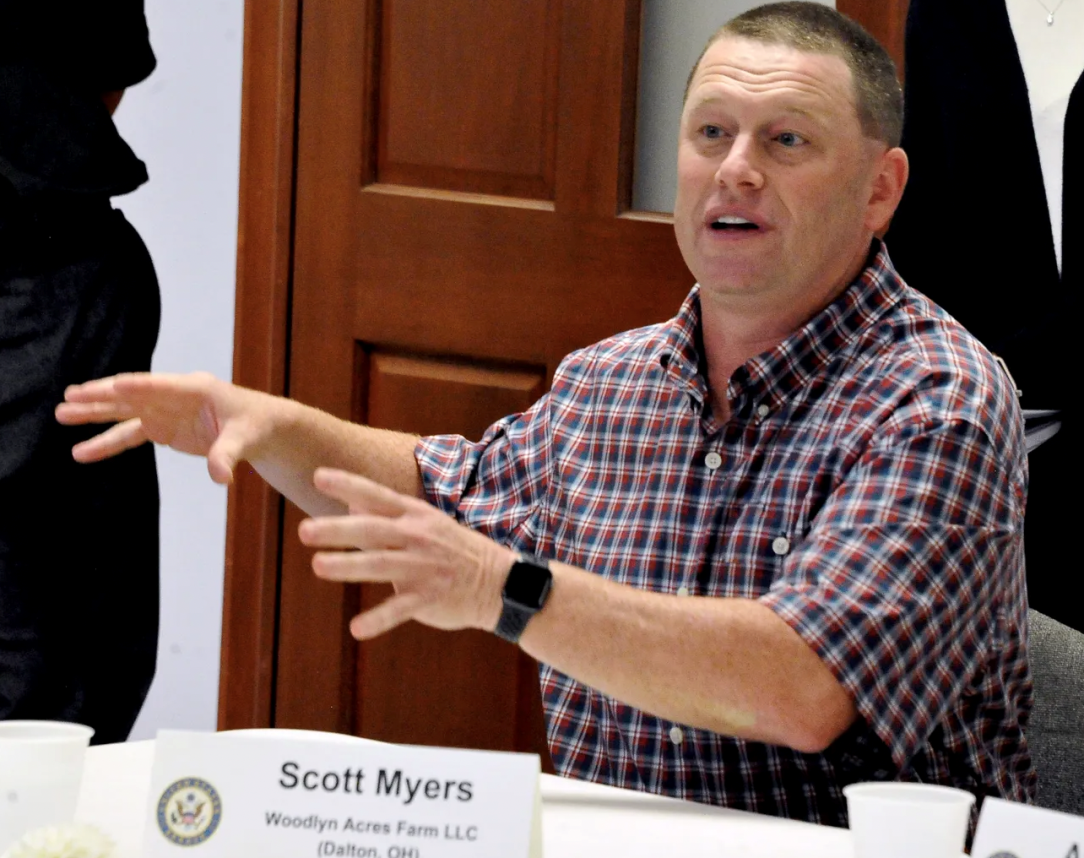
Scott Myers raises awareness about organic fraud and the need to increase domestic production of organic grains.
Some farmers grow organic crops to earn the higher premium paid for such crops. Others farm organically because they are committed to the organic ideal of growing foods that are better for people and the planet. Scott Myers, who farms in Wayne County, Ohio, falls into the latter category.
“I’ve been an organic farmer for nine years, and even if the organic label went away, I would still farm organically because I believe in it,” he says.
Myers provides an excellent example of a successful organic farmer and has become a leading advocate for organic farmers and the challenges they face, including concerns over imports of grain fraudulently labeled as organic.
“Nice size family operation”
Myers farms 2,250 organic acres. “My father and I farm together and we have four full-time employees, so it’s a nice size family operation,” he says.
Myers grows 10 different organic crops including corn, soybeans, several varieties of wheat, barley, cereal rye, sunflowers, peas, oats, and hay.
Yields on organic corn and soybeans are as good as conventional GMO corn.
“On corn and soybeans, on any crop, we’ve proven that we can raise just as good of yields organically as we could conventionally,” Myers says.
Myers’ farm is in an area with a large concentration of Organic Valley dairy farms, and those farms need organic hay as feed.
“We usually grow about 700-800 acres of hay that we sell to these dairies, and
organic hay is another big part of our operation,” Myers says.
In addition to being certified organic, the Myers’ farm is also certified by the Real Organic Project and is in the process of becoming Regenerative Organic Certified (ROC).
One of their wheat-buying customers, Farmer Ground Flour, based in New York state, requested that Myers receive ROC certification, which he says wasn’t difficult.
“We did not have to change anything because we’re already doing all those things [required for ROC certification],” he says.
Fraud is “a lot bigger problem than what even most people even realize”
Myers has been a strong advocate for organic farming and speaking out about the challenges organic farmers face. He is chair of the Policy Committee of the Organic Farmers Association. One issue that Scott has spoken out against is imports of corn and soybeans falsely labeled organic.
“I’ve had my eyes opened in the last 18 months to what I really always thought was a problem, but it’s a lot bigger problem than what even most people even realize,” he says.
Last year, the U.S. Department of Agriculture implemented the Strengthening Organic Enforcement (SOE) rule to crack down on fraud in organic farming and food production. Jennifer Tucker, NOP deputy administrator at the time, said SOE is “shutting the door” on illegitimate shipments of organic commodities.
But last fall, the NOP issued a letter to organic certifiers warning them about possible fraudulent imports of organic soybeans and soybean meal from West Africa. Myers recently expressed concerns about the integrity of organic grain imports on a Real Organic Project podcast.
As much as 75% of organic soybeans used in the U.S.—mostly for poultry feed—come from Argentina, Africa, and Turkey.

The Myers Family, from left to right: Rowan, Scott’s wife Nicole, Henson, Callum, Scott, and Gannon
Organic Imports Verification Act of 2025
Myers is hopeful that new legislation, the bi-partisan Organic Imports Verification Act of 2025, introduced in U.S. Congress in April, can help stem the tide of fraudulent shipments. The bill would require the USDA to establish testing to ensure the integrity of feedstuffs imported as organic,
“We’re really hoping that this bill can help stop the fraud,” Myers says.
The bill is supported by leading organic organizations including the Organic Trade Association, Organic Farmers Association, and National Organic Coalition.
Many people in the organic industry don’t want to talk about the fraud problem.
“They say we don’t want consumers to know, but it hurts the integrity of the organic label,” Myers says. “It’s important to have integrity with your customers; you want to make sure they can trust what they’re getting.”
Those hurt the most by the fraud of organic imports are U.S. organic farmers like Myers who do their best to produce quality organic crops like soybeans.
Myers would like to see U.S. companies encourage more domestic production of organic soybeans and soybean meal, which would reduce reliance on exports and thus reduce the fraud problem, but he sees resistance by domestic buyers.
“Buyers here say they would like to buy domestic grain but can’t get a consistent supply—but we could provide that if we have a level playing field,” he says. “We just want to make sure we are playing by the same rules.”
No matter what happens, Scott Myers is committed to organic farming.
“I couldn’t go back [to conventional farming],” he says. “If the organic premium disappeared tomorrow, we can still farm the way we are organically and sell it conventionally. It wouldn’t be as profitable, but we could still do that and make a living.”
Advertisements