By Kendra Morrison
For nearly three decades, John Fagan has worked at the intersection of molecular biology and food system transparency, helping build the scientific infrastructure behind the non-GMO movement. From early GMO detection methods to his current work in advanced analytical testing, his career traces how the organic and non-GMO sector has learned to define and verify integrity.
Fagan founded Genetic ID in 1996 as genetically engineered crops entered global markets with little practical oversight. Regulators lacked even the most basic tool to distinguish engineered crops from conventional ones. “They had been confronted with an unsolvable problem,” Fagan shared. By introducing genetic testing, he reframed the issue entirely. “You can test for them,” he recalled explaining to European officials, a shift that “gave them the power to make decisions.”
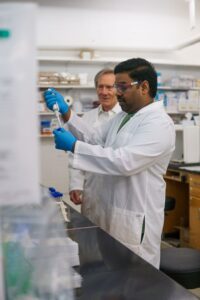
HRI Labs visit with John Fagan
That capability helped establish testing as the backbone of non-GMO verification. Genetic ID went on to launch laboratories in the United States, Japan, and Europe and trained labs in 17 countries. “That was our most important contribution,” Fagan affirmed with a smile. The same early infrastructure helped catalyze what became the Non-GMO Project, as retailers and brands moved to protect “the integrity and the credibility of the organic industry.”
Fagan’s current work has moved beyond GMOs. “The most interesting findings have not been in the area of contaminants, but in the area of nutrients,” he revealed. His lab has identified measurable relationships between farming practices and food quality. “The way that farmers grow the food really makes a big difference,” he explained, pointing to consistent differences in nutritional profiles tied to production methods.
Testing has exposed persistent inconsistencies within the marketplace. “There isn’t always correlation between the quality of what’s inside the package and the labeling,” Fagan exposed. Analytical results do not consistently align with branding, claims, or price.
As datasets expand, patterns emerge, but so do new uncertainties. Fagan’s lab has measured thousands of compounds within common foods, revealing how much remains unknown. In wheat, “we could find matches for only 15% of the compounds” in scientific literature. The rest, he said, are “beyond the frontiers of science as we know them today.” A reminder of how little we still truly know. “There are always limits to what you can measure,” Fagan reconciled.
Even with those constraints, testing can provide insight into how food was produced. It can identify pesticide exposure and, increasingly, signal differences in production systems through nutritional patterns. In ongoing research, Fagan described how fermented forage systems alter both productivity and composition. “The fermentation liberates the nutrients in a different way,” he said, describing shifts in how inputs are converted into usable nutrition. Such findings suggest that measurable outcomes could play a larger role in evaluating agricultural systems.
Organic certification, he added, relies heavily on process and documentation. “It’s a document based system,” he said, with limited testing requirements relative to the scale of the market.
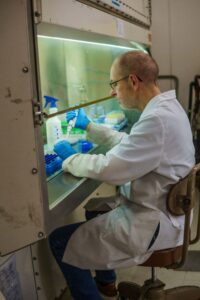
HRI Labs visit with John Fagan
Even where testing is applied, methodologies vary. Detection limits differ widely across laboratories, shaping what is reported as present or absent. Less sensitive methods can produce “clean” results without capturing low-level residues, while more rigorous testing reveals a more detailed picture of exposure. The result is an uneven analytical landscape where conclusions depend as much on methodology as on the product itself.
“Testing by itself is only part of the equation,” Fagan stated. Without traceability and chain-of-custody controls, results can be compromised at multiple points between production and purchase. Verification depends on a system, not a single data point.
As biotechnology evolves, these challenges are intensifying. The growing complexity of GMOs is a central issue as new techniques outpace existing detection frameworks. At the same time, regulatory systems have struggled to keep up. Fagan pointed to frameworks that allow companies to self-certify product safety as a structural weakness.
In one case, his lab identified “over 200 fungal proteins” and dozens of previously uncharacterized compounds in a fermentation-derived ingredient that had been deemed acceptable.
Fagan argues that the next phase of the industry will depend on aligning scientific capability with regulatory and market systems. “What will really be important would be honest regulations,” he concluded. As testing technologies continue to advance, the challenge will not only be generating more data, but using it to bring standards, practices, and measurable outcomes into closer alignment.
Sources: Earth Open Source. “Roundup and Birth Defects: Is the Public Being Kept in the Dark?” 2013. “GM Soy: Sustainable? Responsible?” 2011. Non-GMO Project. “Non-GMO Project Standard, Version 16.” 2025. U.S. Food and Drug Administration. “Toxicology and Risk Assessment of Food Ingredients: GRAS Notice Inventory.” 2025. U.S. Environmental Protection Agency. “Glyphosate: Interim Registration Review Decision Case Number 0178.” 2020 (ongoing review updates through 2024–2025). California Office of Environmental Health Hazard Assessment. “Proposition 65 Carcinogen Identification and Risk Assessment Methodology.” 2023 update. U.S. Department of Agriculture Economic Research Service. “Food Traceability One Ingredient in a Safe and Efficient Food Supply.” Amber Waves Article, April 2004.
Advertisements