
By Kendra Morrison
On the outskirts of Mexico City, the chinampa system operated by Arca Tierra offers a working example of a fully integrated biological production system in practice. Built within a wetland landscape, the farm is rooted in a system where water, soil, and organic matter function together as a continuous cycle of fertility.
The system itself is not new. Chinampas, or floating gardens, supported intensive food production in the Valley of Mexico for centuries prior to industrial agriculture, helping sustain large urban populations in and around Tenochtitlán. Historical accounts describe a landscape of highly productive wetland agriculture that combined dense cultivation with constant nutrient replenishment through canal sediments and organic matter. Chinampas represent a long established production system grounded in ecological management.
Photos by Pablo Antoli
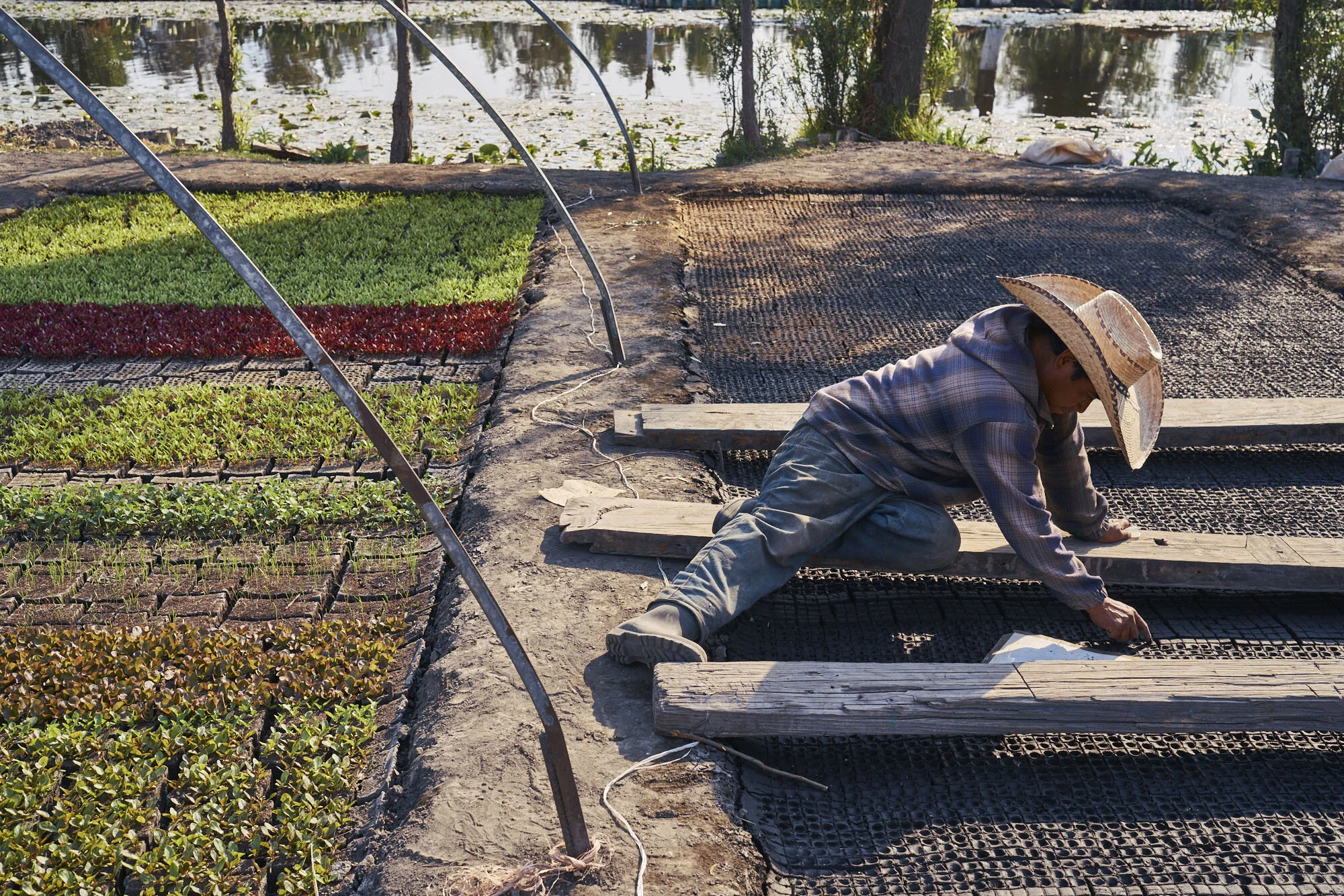
At Arca Tierra, that structure remains visible in how the farm is organized and managed. “This is a wetland ecosystem where chinampas were built using organic matter to raise the islands, to raise the beds,” said founder Lucio Usobiaga. “We have our main canals, our secondary canals. The secondary canals are used for irrigation.”
Chinampa farming operates as a raised-bed cultivation system built within shallow freshwater canals. Farmers construct elongated planting beds using layers of mud, decomposed vegetation, and organic matter dredged from the canal bottoms. These beds sit slightly above the waterline while remaining hydraulically connected to the surrounding channels. Water continuously moves through the system at a slow rate, carrying dissolved nutrients and suspended organic material into contact with the root zones. Fish and other aquatic organisms in the canals contribute to this nutrient flow through waste outputs that break down into nitrogen and other plant-available compounds, supporting microbial activity and plant growth. Canal sediments are periodically extracted and reapplied to the beds, recycling fertility within the same landscape. Planting is arranged in dense, linear rows along the length of each bed to optimize access, drainage, and nutrient uptake while maintaining constant interaction between soil, water, and biological activity.
Within that structure, fertility is generated internally through repeated biological processes. “Our main sources of fertility are mostly the mud we use for our seeding,” Usobiaga explained. “We also use organic matter to mulch, and that helps us a lot.” External inputs exist but are secondary rather than foundational. “We sometimes use manure, external input. Sometimes we buy compost.”
Plant health and pest management follow the same logic of biological regulation. “We use microbiology as pest control, and so we don’t use any synthetic pesticides or herbicides,” he said.
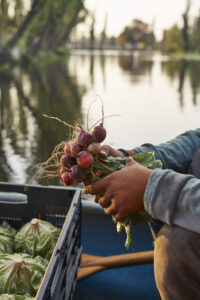
The system supports multiple harvest cycles rather than a single peak output. “We normally have about four or five harvests per year on a single bed,” Usobiaga noted. “Our production is stable, we produce all year round, but during winter it’s slower.”
That production pattern shifts the way productivity is understood. Instead of focusing on a single seasonal yield, the system generates repeated harvests across the year, shaped by biological activity, climate variation, and water availability.
Environmental conditions remain a defining factor. Water levels in the system are managed externally and fluctuate seasonally. “It fluctuates depending on the season,” Usobiaga shared. The farm operates within those shifts, with slower cycles during frost periods and renewed growth as water returns in the rainy season.
“We know that if we keep it diverse and we give back to the soil, we have a healthy plant,” he said. Pest pressure increases during the rainy season, but the system is designed to absorb variability through diversity rather than eliminate it.
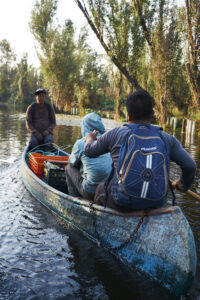
While the system is highly productive within its ecological context, it is also geographically specific. “For chinampa, you need wetlands. It’s a wetland type of agriculture,” Usobiaga said. “It’s a very shallow canal, and the organic matter is very important, the mud.”
Photos by Pablo Antoli Originally published at https://www.antolistudio.com/stories/arca
The system points toward replication across suitable landscapes, and encourages a symbiotic partnership with the natural ecosystems through agroforestry.
Usobiaga emphasized that what makes the system work is not a single input or technology but the integration of ecological practices over time. “I think it’s following the seasons, giving back to the soil with fertilizer, manure, compost, having a diverse polyculture system, and learning the traditional methods with contemporary inputs such as microbiology,” he said, pointing to agroforestry and mulching practices as transferable elements that could be adapted beyond Mexico.
Arca Tierra also operates with a direct to consumer strategy that aligns with its production model. By selling directly, the farm reduces dependence on long supply chains that favor uniform, high volume crops. Instead, it moves diversified production through shorter channels where value is captured closer to harvest. This approach supports the economics of a system built on frequency and diversity rather than scale alone.
Chinampa agriculture demonstrates how tightly managed biological systems can sustain productivity through internal nutrient cycling. The key is to replicate their biological dynamic across various environments, working with the logic of specific ecosystems, not against it.
When nutrient cycles are maintained and managed at the system level, productivity depends on how consistently biology is allowed to operate.
Sources: World History Encyclopedia. “Chinampas: Mexico’s Human-Made Agricultural Islands.” 2025. Encyclopaedia Britannica. “Chinampa.” 2026. Food and Agriculture Organization of the United Nations. “Chinampas Agricultural System in Mexico City, Mexico.” Globally Important Agricultural Heritage Systems (GIAHS). 2017. Calnek, Edward E. “Settlement Patterns and Chinampa Agriculture at Tenochtitlan.” American Antiquity. 1972. Sanders, William T., Parsons, Jeffrey R., and Santley, Robert S. The Basin of Mexico: Ecological Processes in the Evolution of a Civilization. Academic Press, 1979.
Advertisements