Connecting food brands to Regenified certified farmers and increasing farmer profitability are key goals of initiative
Regenerative agriculture certifier Regenified is trying to build premium markets for non-GMO corn grown by the group’s certified farmers. In the process, they want to build more direct farmer-to-brand supply chains for regeneratively produced crops.
“Perfect marriage of opportunity”
The aim of the initiative is to connect food brands with certified regenerative farmers says Salar Shemirani, Regenified’s CEO.
“Our ability to connect people has become something that we are really interested in, and we want to make sure that we play a role to support that connection and transactions,” he says.
Shemirani sees the initiative as “a perfect marriage of opportunity,” saying the “buyers are there and the farmers at Regenified supply chains growing those crops are there.”
Regenified chose non-GMO corn because there is consumer demand for non-GMO foods.
“Whether it’s a turkey that is produced regeneratively and being fed non-GMO corn, or an egg production facility that feeds non-GMO Regenified corn to its flocks, that interest and appetite by consumers is certainly there,” Shemirani says.
The goal is also to build better—and regenerative—supply chains for non-GMO corn for food and feed.
“We are willing to support those organizations who already buy non-GMO corn to have access to a more traceable and transparent supply of non-GMO corn,” Shemirani says.
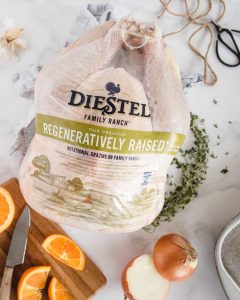
Diestel Family Ranch’s Regeneratively Raised Turkey
Premium markets for farmers
The benefit to farmers is accessing premium markets for their regenerative crops and earning better prices for their crops.
“For farmers, the choice to be able to grow non-GMO is something that is more liberating than to have to grow GMO corn where you are growing it just to make some dollars selling it to ethanol plants,” Shemirani says. “Our hope is that farmers who are practicing regeneratively realize the full scale of profit potential that is in regenerative agriculture.”
Another aim of the program is to shorten supply chains between farmers and food brands; these have traditionally been long, with several intermediate parties such as grain elevators and buyers and processors. The result is often poor compensation for farmers.
“By enabling direct transactions between farms and buyers, you’re essentially retaining more of that cut in the system available for the producer,” Shemirani says. “That reduces the burden for a buyer to pay more because they’re no longer buying from middle players. They’re buying directly from a farmer.”
Selling non-GMO corn to Diestel Family Ranch
Greg Thoren is one of the Regenified farmers growing non-GMO corn for the program. He farms 2,200 acres near Stockton, Illinois with 1,400 of that being non-GMO corn.
He sells the corn to Diestel Family Ranch, a family-owned producer of sustainably raised turkeys based in Sonora, California. Diestel, which is also Regenified certified and Non-GMO Project Verified, uses Thoren’s corn as feed for their turkeys.
Thoren grows non-GMO corn because he’s found it withstands rootworm pests better than GMO corn and because the input and seed costs are less.
“I can almost guarantee I’ll have a higher net profit or return rate because I don’t have all the input costs [of GMO corn],” he says.
Thoren doesn’t use any insecticides or fungicides on his corn and is reducing the amount of herbicides.
He grows multi-species cover crops to reduce the need for chemicals, keep living roots in the ground, and build soil health.
Thoren sells the rest of his non-GMO corn to an ADM facility in Iowa but hopes to get another premium market participating in the Regenified program.
He expresses frustration that large food companies don’t want to pay for regeneratively produced crops.
“We do all these practices on the farm to make our products better for health and the environment, and they don’t want to pay any more money for it,” he says.
Thoren believes he produces a better, more nutritious product. In fact, a 2024 study conducted at Utah State University found that Diestel turkeys grown with regenerative farming practices and fed Thoren’s corn can improve fatty acid ratios and phytochemicals in turkeys.

Mark Portner is his field of non-GMO regenerative corn
Regenerative agriculture changes the way you approach life
In South Central Minnesota, Mark Portner is also growing non-GMO corn for Regenified’s initiative. He farms 700 acres 280 acres of which is non-GMO corn. He also grows several wheat varieties and small grains and raises beef cows.
Portner also sells his non-GMO corn to Diestel Family Ranch but is looking for other markets.
“I’m hoping Regenified is able to find some more premium markets,” he says. “I’d like to see that market flourish so that we as farmers can try to capitalize on that.”
Like Greg Thoren, Portner uses no insecticides, has reduced the use of other inputs such as synthetic fertilizers, and grows cover crops such as sorghum sudangrass, oats, sunflowers, barley, and others.
He calls regenerative agriculture a journey. “It’s challenging; it changes the way you approach farming, the way you approach life. Being in touch with nature really changes it.”
Portner is also convinced of the nutritional value of regeneratively produced crops. “You’re creating a better product; you’re getting better feed to those animals, which in turn will provide a better food source for human consumption,” he says.
Beyond that, Portner sees regenerative agriculture as a way to rebuild rural communities hollowed out by industrial agriculture and its factory farms.
“I look at this as a possibility where you could build up the rural community or keep it vital and strong, where you provide opportunities for everybody,” he says.
Transitioning U.S. agriculture to regenerative
There are 70,000 acres of non-GMO corn in Regenified’s program, according to Kristine Root, Regenified’s chief marketing officer.
“This reflects strong momentum from producers who see value in verified, regenerative supply chains,” Root says.
Thoren sold Diestel 24,000 bushels of non-GMO corn last year and 14,000 bushels so far this year. Portner supplied Diestel 20,000 bushels this year.
Still, the non-GMO corn initiative is in its early stages. “We’re continuing to build partnerships with brands and farmers aligned with regenerative and non-GMO goals,” she adds.
Looking at the big picture, Regenified aims to help transition U.S. agriculture from industrial methods, which are known to harm human health and the environment, to regenerative, with its focus on building soil health and producing nutrient dense foods.
“The more products that are being sourced from farms that are practicing regeneratively and are growing non-GMO, the more chance we have to transition our conventional agriculture system to a more regenerative system that works in harmony with nature,” Shemirani says.
Advertisements