
To access all the articles in this month’s issue of The Organic & Non-GMO Report, SUBSCRIBE NOW.
Number of participating retailers grows by 30% over last year’s event
The second annual Non-GMO Month will exceed last year’s event with a Right2Know March, more participating retailers, more non-GMO verified products on sale, more events, and a new website.
Non-GMO Month was launched by the Non-GMO Project in 2010 to raise awareness about problems with genetically modified foods and to highlight the availability of non-GMO food options. The focus of Non-GMO Month activities is at the retail level. Last year nearly 600 natural foods retailers participated in Non-GMO Month by hosting events, distributing educational materials, and featuring Non-GMO Project Verified products on their shelves.
30% more retailers involved
This year’s event promises to be even bigger and better, says Non-GMO Project executive director Megan Westgate. “We have 800 retailers so far (as of early September), which is 30% more than last year, and that number will go up. We’re not only growing the number of stores but their participation is deepening.”
A major highlight of this year’s Non-GMO Month is the Right2Know March from New York City to Washington, D.C., October 1-16, that will raise awareness about the need for mandatory labeling of genetically modified foods.
A new website was launched, www.nongmomonth.org, that allows all users to create and participate in non-GMO events during the month of October.
Sales of Non-GMO Project verified products are growing 24% per year, which is faster than gluten-free, fair trade, and other natural food categories. At the end of July, the Non-GMO Project had 5,219 products going through non-GMO verification and some 2500 verified products. The Project’s Facebook page has attracted more than 45,000 fans with more joining all the time.
Commitment to non-GMO and organic
One of the retailers participating in Non-GMO Month is New Frontiers Natural Marketplace based in Solvang, California with four other locations.
Ron Colone, marketing director, says his store is trying to educate its customers about GMOs. “We are putting out as much educational material as we can to raise awareness of this issue.”
One example is New Frontiers’ GMO Statement that expresses its commitment to “actively seek to avoid GMOs.” The statement is displayed in all five of its stores.
New Frontiers demonstrates its commitment to non-GMO and organic by having its own organic farm. “Our commitment has long been with organic,” Colone says.
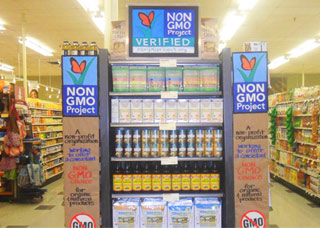
For Non-GMO Month, New Frontiers will create “endcap” displays at the end of aisles with Non-GMO Project verified products, distribute educational materials such as Non-GMO Shopping guides, offer in-store seminars on GM foods, and raffle Non-GMO Project tote bags filled with verified products. New Frontiers will also donate 5% of sales on the third Wednesday of October to the Non-GMO Project.
“Most important food issue affecting us”
One of the new sponsors of Non-GMO Month is natural food distributor Tree of Life. “GMOs in agriculture have been a significant concern to us for some time,” says Greg Leonard, senior vice president of natural food sales. “Thankfully the Non-GMO Project provides a focal point for action that all of us in the natural products industry can support.”
Tree of Life supplies natural food stores nationwide with organic and natural products and is working with these retail customers to promote Non-GMO Month.
“We wanted to use our retail relationships to help mobilize a large number of natural food stores in support of Non-GMO month,” Leonard says.
Tree of Life was able to sign up some 350 stores, some of which have multiple locations, to participate in Non-GMO Month, according to Leonard.
Tree of Life has also enrolled over 100 of its own brand products with the goal of having all 500 of its branded products Non-GMO Project verified.
Leonard sees Non-GMO Month and other non-GMO initiatives as critical. “This is clearly one of the most important, if not the most important, food issues affecting us as a country,” he says. “At the end of the day, it is imperative that food manufacturers, distributors, and retailers work together to make sure consumers have the right to choose foods from non-GMO sources.”
© Copyright The Organic & Non-GMO Report, October 2011