
Non-Ultraprocessed is Latest Food Certification Trend
With increasing concerns over the health risks of ultraprocessed foods (UPFs), programs to certify foods as non-ultraprocessed—private and public—are being established.
California Governor Gavin Newsom recently signed legislation (AB 2244) to create a certification program and label identifying non-ultraprocessed foods (non-UPF), becoming the first U.S. state to create such a label.
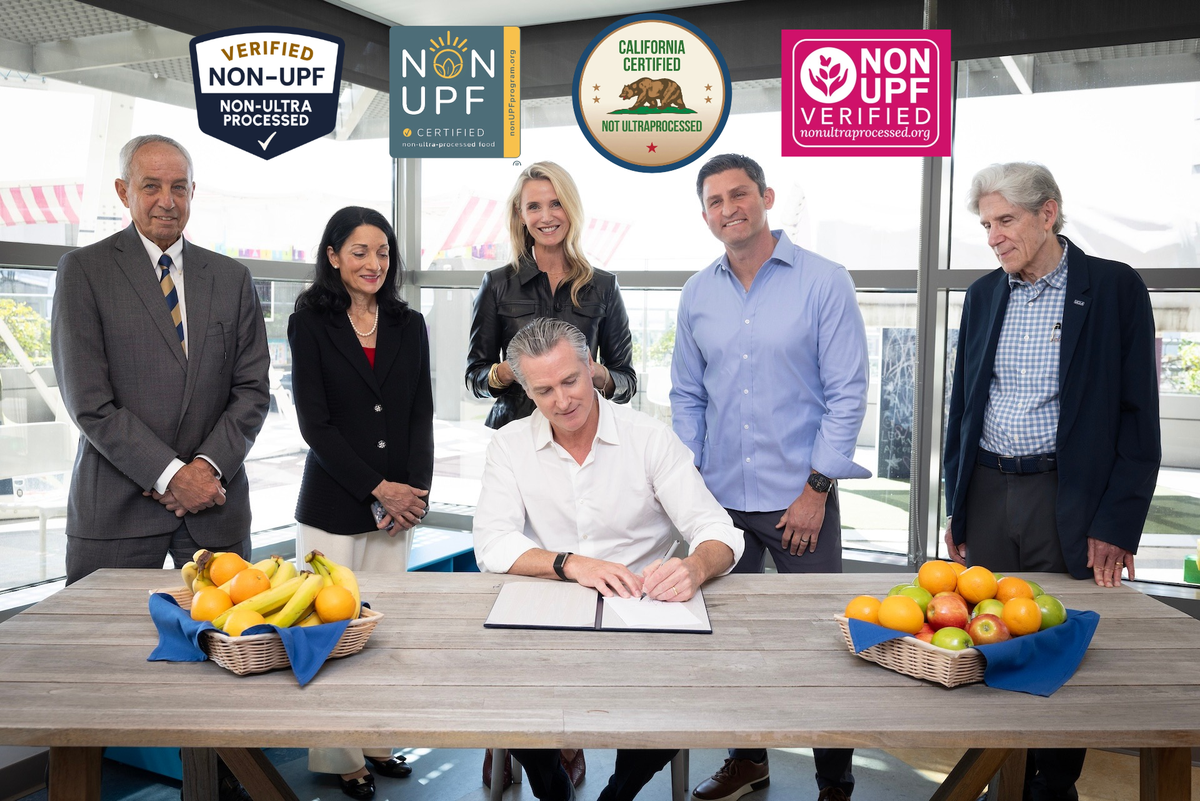
California Governor Gavin Newsome signs legislation creatingi a non-ultraprocessed food certification program in California.
“Like the USDA Organic Label”
The “Non-Ultraprocessed Certified” label aims to make it easier for Californians to find healthier foods. It will provide clear, front-of-package information and improved access to healthier options through strategic, in-store placement.
“It’s why California is focused on making whole, healthy foods as accessible as possible, why we’re making healthier choices easier,” Newsome said.
California Assemblymember Jesse Gabriel said the new non-UPF label will increase transparency for consumers. “Like the USDA Organic label, this new seal will provide consumers with clear, trustworthy information and make it easier for them to locate healthier foods that are free from harmful additives,” he said. “Parents shouldn’t need a Ph.D. in chemistry to understand what they’re feeding their kids.”
Bernadette Del Chiaro, senior vice president of the Environmental Working Group for California also praised California’s Non-UPF certification. “This is about setting a higher bar for what we consider healthy food and helping consumers make wise choices,” she said. “Consumers deserve labels they can trust. And families deserve a simple way to tell which foods are closer to what comes from a kitchen rather than a factory.”
Builds on California’s Prior Work to Address UPFs
The California Department of Public Health will oversee certification of products that meet the state’s non-UPF standard, and will approve and accredit third-party certifiers to conduct product certifications. The law directs the department to accredit these third-party certifiers no later than June 1, 2029. Products must be recertified at least every three years.
The certification legislation builds on California’s prior work to address UPFs and other foods and ingredients linked to serious health harms, including cancer, cardiovascular disease, Type 2 diabetes, metabolic disorders, reproductive harm, and other chronic conditions. Despite these health risks, more than half of Americans’ daily calories come from ultra-processed foods, according to federal data.
Last year, Governor Newsome signed the Real Food, Healthy Kids Act (AB 1264), making California the first state to officially define UPFs and setting a timeline for phasing them out of schools.
More States Taking Action Against UPFs
California isn’t the only state taking action against ultraprocessed foods. Arizona banned UPFs in schools this year, and New York City has eliminated processed meats and sweeteners in school meals and in other city facilities. According to the Environmental Working Group, more than 150 bills to protect consumers from food chemicals have been proposed or passed in U.S. states.
At the federal level, the Department of Health and Human Services and the U.S. Department of Agriculture recently submitted the government’s first proposed definition of ultraprocessed foods to the Office of Management and Budget. Reducing the consumption of UPFs is a major focus of HHS Secretary Rober F. Kennedy, Jr.’s Make America Healthy Again initiative.
Ingredient minimalism—the opposite of ultra-processing—is one of Whole Foods Market’s top food trends for 2027. “Fueled by viral ‘read your labels’ social content and growing scrutiny around additives and ultra-processed foods, shoppers are embracing pared down ingredient lists as a marker of quality,” Whole Foods said. “Manufacturers are responding by simplifying formulations, replacing once-lengthy ingredient lists with concise ones.”
“It’s just shocking that we’re allowed to have this stuff in our food supply”
While government programs are beginning to address the risks of UPFs, three private non-UPF labeling programs have emerged in the past two years.
The first non-ultraprocessed food certification program to appear on the market was Non-UPF Program, which was launched in December 2024. According to founder and president Melissa Halas, the significant increase in food allergies among children was a major reason for founding the program.
“What I was seeing is a really high increase in food allergies now, compared to when I counseled 25 years ago,” said Halas, who is a registered dietician. “I also discovered that children who eat a higher ultra-processed food diet are missing out on many micronutrients, like vitamin D, zinc, iron, and certain B vitamins.” She adds: “It’s just shocking to me that we’re allowed to have this stuff in our food supply.”
Such micronutrient deficiency along with consumption of food additives in UPFs, Halas said, is the beginning of DNA damage that can lead to cancers later in life. “I thought that something needs to get done, and it needs to be more than just the label,” Halas said about launching the Non-UPF Program.
In addition to certification, the Non-UPF Program also focuses on education and collaboration. Specifically, this means educating food companies, health care practitioners, and consumers about the health risks of UPFs and collaborating with researchers to advance the science to reveal those risks.
Halas sees a “ton of interest” from consumers for non-UPF foods, citing research showing that one in three consumers are looking for non-UPF foods. “Non-UPF certification is a growing trend,” she said. “There are growing concerns about the health risks of UPFs, and now there are certifications that are emerging.”
Halas said her group has worked extensively to identify hundreds of additives and ingredients classified as Nova Group 4, which refers to ultraprocessed foods in the NOVA Food Classification System. This system categorizes foods based on the degree to which they have been industrially processed.
Non-UPF Verified
The Non-GMO Project, the leading verifier of foods not produced with genetically engineered ingredients, launched their Non-UPF Verified program earlier this year. Since then, the Non-UPF Verified has gained significant traction in the marketplace, verifying 304 products across 23 brands.
A Non-UPF Verified app lets shoppers scan packaged foods to see whether they are verified, learn more about food processing and request verification from brands.
“When we launched Non-UPF Verified earlier this year, we knew people were asking deeper questions about how their food is made,” said Megan Westgate, CEO of the Non-GMO Project. “Seeing more than 300 products achieve verification in a matter of months shows that brands are ready to meet that demand with greater transparency. People deserve meaningful information that goes beyond what they can see on an ingredient list.”
Non-UPF Verified’s standard for verification is designed to evaluate how food is processed. both what goes into a food and the processes used to make it. At least 70% of a product’s ingredients must meet the standard’s requirements for permissible minimal or moderate processing, while certain ingredients and processing methods associated with ultraprocessed foods are restricted or prohibited.
Need for Uniform Non-UPF Standard?
Another non-ultraprocessed verification program is offered by WISECode Labs™. Their Verified Non-UPF program provides an online “WISE intelligence system” that allows food companies to enter their products’ ingredients and apply for verification. Verified products can then display the Verified Non-UPF seal. Verified Non-UPF also offers an app, WISEcode UPF Detector, that lets consumers find verified products.
With several non-UPF programs emerging, is there a need for a uniform non-UPF standard to prevent a patchwork of different standards?
Halas doubts the ability of the U.S. government to do this. “Whatever the government pushes for is going to have too much (food industry) lobbying, and it’s going to be too loose of a standard,” she said.